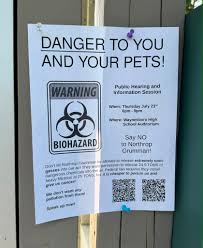
The debate over Northrop Grumman’s proposed Waynesboro facility is no longer just about economic development — it is now about what levels of industrial emissions the Shenandoah Valley is willing to accept and whether current safeguards are enough to protect nearby communities.
Tonight, the Virginia Department of Environmental Quality (DEQ) is holding a public hearing on Northrop Grumman’s proposed air permit for its new Waynesboro facility. While the facility is located in Waynesboro, the air we breathe does not stop at city limits. What is released into our air can affect surrounding communities, including Staunton, Fishersville, Verona, and the greater Shenandoah Valley.
When many residents first heard Northrop Grumman was coming to the Valley, they understood it as a new employer and economic development project. What many people did not realize is that this facility is not only an office or research site — the permit application is for an advanced electronics assembly and testing facility that would involve manufacturing processes requiring coatings, solvents, and other materials.
Now, residents are asking an important question:
Are the proposed limits and protections strong enough to protect the people who live here?
What is Northrop Grumman asking for?
According to the draft permit documents, Northrop Grumman is seeking permission to operate while limiting hazardous air pollutant emissions below the federal threshold that would classify the facility as a “major source.”
The proposed limit is:
- 9.9 tons per year of any single hazardous air pollutant
- 24.9 tons per year of combined hazardous air pollutants
The federal major-source threshold for combined hazardous air pollutants is 25 tons per year. That means the proposed limit is just below that level.
Residents are asking whether being just below a regulatory threshold automatically means the strongest possible protections are in place.
What chemicals are involved?
The permit identifies emissions associated with substances including:
- Methyl Isobutyl Ketone (MIBK)
- Toluene
- Xylene
- Volatile Organic Compounds (VOCs)
- Particulate matter, including PM2.5 and PM10
These materials are commonly used in industrial processes, including coatings, cleaning, and manufacturing.
The concern is not simply that these chemicals exist — it is about how much is released, how exposure is monitored, and whether protections are sufficient for the surrounding community.
Why are residents concerned about VOCs?
Volatile Organic Compounds (VOCs) are chemicals that easily evaporate into the air.
Depending on exposure levels, VOCs can contribute to:
- ground-level ozone formation
- respiratory irritation
- headaches and dizziness
- impacts to air quality
The permit identifies VOC emissions from processes including:
- spray coating
- cleaning operations
- solvent use
- adhesive removal
- coating-related activities
Concerns about toxic pollutants
The permit specifically identifies chemicals such as toluene, xylene, and MIBK.
Residents are raising questions because these pollutants have documented health concerns at certain exposure levels.
Potential concerns include:
Toluene
- nervous system effects
- headaches and dizziness
- concerns with repeated exposure
Xylene
- respiratory irritation
- dizziness
- nausea
- nervous system effects
MIBK
- eye and respiratory irritation
- headaches and dizziness
- concerns with repeated exposure
The question residents are asking is not whether these chemicals are used in industry — it is whether the community has enough information and monitoring to understand potential impacts.
PM2.5: The pollution you cannot see
The permit also identifies particulate matter emissions, including PM2.5.
PM2.5 particles are extremely small and can travel deep into the lungs.
Long-term exposure to fine particulate matter has been associated with serious health concerns, including:
- worsening asthma
- respiratory problems
- heart disease risks
- stroke risks
Because these particles are so small, residents want to know how emissions will be tracked and what protections will be required.
One major concern: No air dispersion modeling
One of the biggest questions raised by residents is that DEQ did not require air dispersion modeling for this permit.
That means the permit does not provide a detailed prediction showing:
- where pollutants may travel
- how concentrations may change in surrounding areas
- what could happen under certain weather conditions
This does not prove that pollution will reach specific neighborhoods.
But it does mean residents are asking for more information about how emissions could move through the Valley before operations begin.
I read the DEQ engineering analysis you uploaded. The document is not evidence that Northrop Grumman will cause specific harm, but it does describe what they are requesting permission to emit, what controls they propose, and where there are potential risks. Below is a breakdown of the issues residents are focusing on, separated from what the permit actually says.
1. Hazardous Air Pollutants (HAPs)
The permit would allow Northrop Grumman to remain just under the federal “major source” threshold by limiting emissions to:
- 9.9 tons/year of any single hazardous air pollutant
- 24.9 tons/year combined hazardous air pollutants
This matters because 25 tons/year combined would trigger additional federal regulatory requirements.
Chemicals listed
The permit specifically identifies emissions of:
- Methyl Isobutyl Ketone (MIBK)
- Toluene
- Xylene
- Volatile Organic Compounds (VOCs)
- Fine particulate matter (PM2.5)
- PM10
- Particulate Matter (PM)
2. VOCs (Volatile Organic Compounds)
These chemicals evaporate easily into the air.
Potential concerns include:
- formation of ground-level ozone (smog)
- respiratory irritation
- eye, nose and throat irritation
- headaches and dizziness after higher exposure
- contribution to poorer regional air quality
The permit states VOCs will come from:
- spray painting
- cleaning solvents
- adhesive removal
- solvent recovery
- coating operations
3. Toluene
Potential health concerns associated with exposure include:
- nervous system effects
- headaches
- dizziness
- developmental risks during pregnancy at sufficient exposure levels
- long-term neurological effects with repeated occupational exposure
The permit identifies toluene as one of the primary toxic pollutants.
4. Xylene
Potential concerns include:
- breathing irritation
- dizziness
- nausea
- effects on the central nervous system
- possible impacts from repeated long-term exposure
Listed as one of the major toxic pollutants.
5. Methyl Isobutyl Ketone (MIBK)
This chemical receives special attention in the permit.
The DEQ notes Northrop’s proposed emissions are very close to Virginia’s hourly toxic limit, so the permit includes special restrictions specifically to keep MIBK below that level.
Potential concerns include:
- eye irritation
- respiratory irritation
- headaches
- dizziness
- possible liver and kidney effects after repeated exposure
6. Fine Particulate Matter (PM2.5)
One of the biggest public health concerns.
PM2.5 particles are so small they can travel deep into the lungs and even enter the bloodstream.
Long-term exposure has been associated with:
- asthma attacks
- COPD
- heart disease
- stroke
- premature death in vulnerable populations
The permit acknowledges emissions of PM2.5 from multiple operations.
7. Spray coating operations
Northrop plans to operate:
- two spray booths
- curing ovens
- coating systems
These produce:
- VOCs
- PM
- PM10
- PM2.5
- hazardous air pollutants
They propose:
- enclosed booths
- high-volume low-pressure spray guns
- three-stage filters rated about 99% for particulates
Those filters do not eliminate VOCs.
8. Solvent use throughout the plant
The permit states solvents will be used throughout the facility for:
- cleaning
- surface preparation
- adhesive removal
- equipment cleaning
It also says:
No control is applied to these VOC emissions.
This is one of the sections residents have questioned.
9. Solvent recovery
Northrop also wants to recycle spent solvents.
These solvents include:
- hazardous air pollutants
- VOCs
Recovered solvents would be reused.
10. Diesel emergency generators
Two diesel generators may operate:
- during power outages
- maintenance
- testing
These emit:
- nitrogen oxides
- sulfur dioxide
- particulate matter
- VOCs
- carbon monoxide
11. No air dispersion modeling
This is one of the largest concerns raised publicly.
The permit states DEQ did not require air dispersion modeling because emissions were below the regulatory thresholds requiring it.
Without modeling, the permit does not estimate:
- where pollutants would travel
- neighborhood concentrations
- impacts during temperature inversions
- effects on Staunton or other nearby communities
That does not mean pollutants will or won’t reach those places—it means the permit does not include that analysis.
12. Monitoring
The permit relies primarily on:
- company recordkeeping
- monthly emission calculations
- monitoring
- DEQ can require testing later if needed
It specifically states:
No testing is currently required.
This is why some residents are requesting:
- continuous emissions monitoring
- fence-line monitoring
- independent verification
These requests are not currently included in the draft permit.
13. Why people are worried
Residents argue that:
- the plant sits below the 25-ton threshold by only 0.1 ton/year
- there is no dispersion modeling
- no fence-line monitoring
- no continuous emissions monitoring
- the Valley’s geography can trap air during inversions
- nearby schools, neighborhoods, recreation areas, and parts of Waynesboro’s water supply are close to the facility
Some of these points (such as geography and nearby locations) are public concerns rather than findings made in the permit itself.
Strongest evidence-based concerns from the permit
If you are speaking at the hearing, the points most directly supported by the permit are:
- The facility is requesting permission to emit up to 24.9 tons/year of hazardous air pollutants, just below the federal major-source threshold.
- The emissions include toluene, xylene, MIBK, VOCs, and PM2.5, all of which have recognized health concerns depending on exposure levels.
- Air dispersion modeling was not performed because the emissions are below regulatory modeling thresholds.
- No routine emissions testing is required in the draft permit, although DEQ reserves the right to require testing later.
- Solvent use throughout the facility emits VOCs, and the permit states “No control is applied” for those emissions.
These points are directly supported by the permit language and are likely to carry more weight in public comments than broader claims that cannot be substantiated from the permit alone.
Monitoring and accountability
The draft permit relies largely on:
- company recordkeeping
- emission calculations
- monitoring requirements
- DEQ’s ability to request additional testing if needed
Residents have raised concerns about whether additional protections should be included, such as:
- independent monitoring
- fence-line monitoring
- more frequent emissions testing
- greater public access to emissions data
The question is simple:
How will the community know what is in the air if there is no stronger system to measure it?
Solvent use and “no control applied”
The permit documents state that certain solvent-related VOC emissions do not have additional controls applied.
Residents are asking why these emissions are not being reduced further and whether additional pollution controls should be required before the facility begins operating.
This is about asking questions before it is too late
This is not about saying a facility will automatically harm the community.
It is about making sure decisions involving public health, air quality, and industrial development are made with full transparency.
Residents deserve to understand:
- What pollutants could be released?
- How will those pollutants be monitored?
- How will surrounding communities be protected?
- Are the current permit conditions strong enough?
Economic development and protecting public health should not be treated as opposites. A community can welcome jobs while still demanding the strongest possible safeguards.
Public Hearing Information
Northrop Grumman Draft Air Permit Hearing
Waynesboro High School Auditorium
1200 West Main Street
Waynesboro, VA
Information briefing: 6:00 PM
Public hearing: 6:30 PM
The hearing is part of DEQ’s public comment process for the proposed permit. Residents can attend, speak, and submit comments.
Because if pollution enters our Valley, it does not stop at a city line.
This affects all of us.
SOURCES
https://www.deq.virginia.gov/home/showpublisheddocument/36683/639172178491730000
https://www.deq.virginia.gov/home/showpublisheddocument/36681/639172178486800000
 Capitol City Chaos